Research Master Cluster — Academic Project
Abstract:
Urbanization is anticipated to increase by 13% over the next three decades, resulting in greater overlap between human and wildlife habitats and heightened disease risk unless effective countermeasures are found. Biological rhythms, integral to the lifecycles of all organisms, regulate physiology, immunity, and interactions such as vector–host dynamics — and rapid urbanization threatens them. The synchronization of host defences with vector and parasite encounters is a product of evolutionary pressure, and is threatened by untimely exposure to environmental cues such as artificial light at night (ALAN). Exposure to ALAN could desynchronize parasite–vector–host rhythms, plausibly increasing or decreasing disease transmission — but this impact remains poorly understood.
I argue that overall transmission will increase, due to (1) cumulative fitness costs for the host and (2) heightened vector activity as a stress response to ALAN. I will investigate this using Plasmodium spp., Culex spp., and great tit (Parus major) as parasite, vector, and host respectively, across urban and forested sites in the Netherlands. First, I will study how ALAN affects daily host defence strategies — immunological, behavioural, and physiological. Second, I will assess ALAN's impact on daily vector ecology — biting behaviour, capacity, activity, and density — to understand how these shape infection risk through vector–host interactions. Third, I will analyse how these daily rhythms, under ALAN, change the probability of disease transmission.
I expect that desynchronized rhythms across the triad will raise infection risk, as mismatches between vector activity and host immune strategies open additional windows for the parasite to infect both host and vector. This study will contribute to understanding both the adaptive significance of biological rhythms under changing environmental cues, and arboviral disease transmission in an increasingly urbanized landscape.
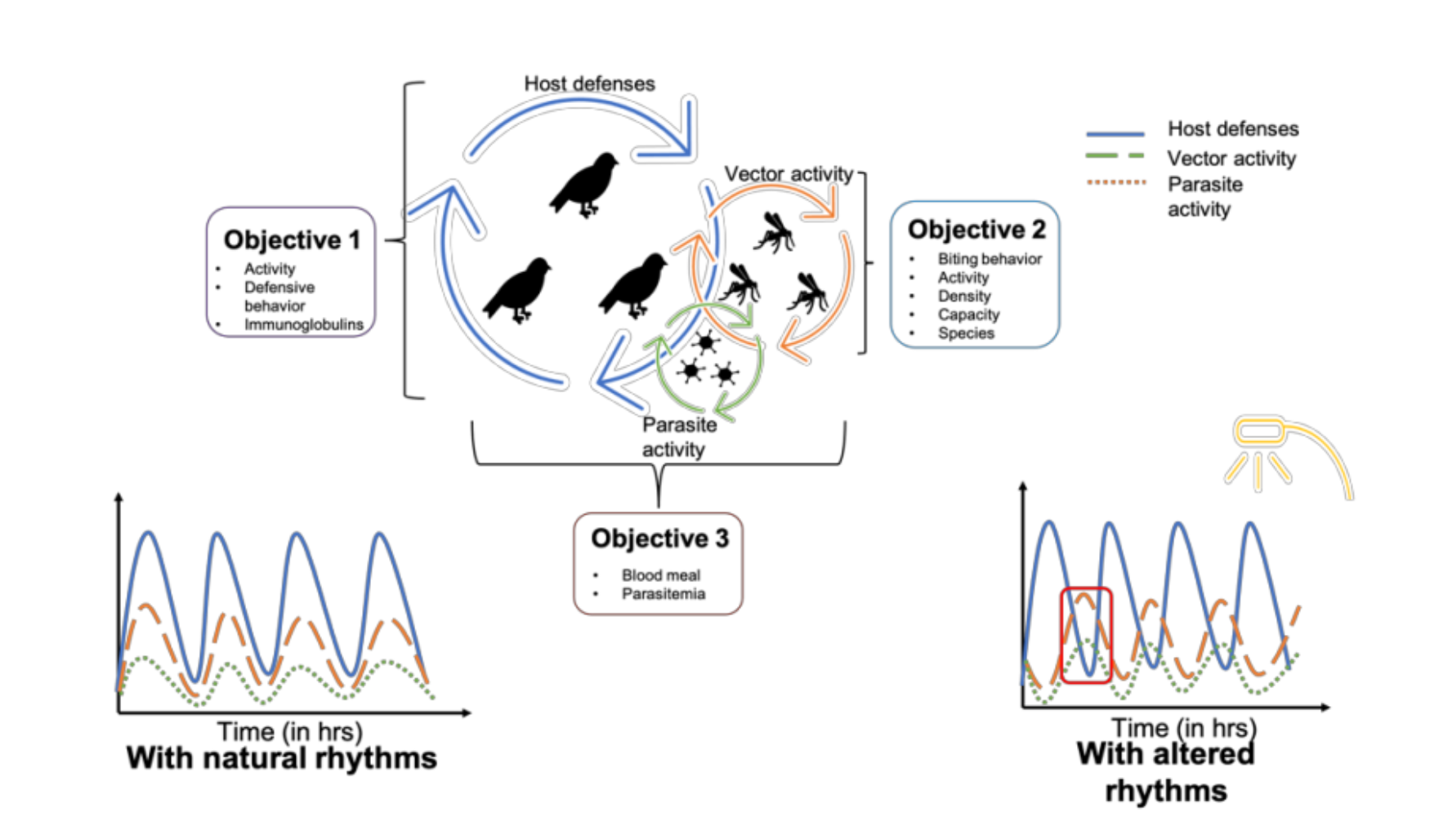 Circular arrows depict the biological rhythms of individuals, while an overlap is seen between the three which allows disease transmission. The graph with natural rhythms depicts the patterns of host defences, vector activity and parasite activity under normal conditions, while the graph with altered rhythms represents the mismatch of the patterns due to exposure to nocturnal lights — the red square shows the window of opportunity for increased disease transmission. Objective 1 is focused on alteration of host defences, Objective 2 is focused on alteration observed in a vector, while Objective 3 includes parasite-vector-host focusing on alterations in disease transmission.
Graduate Research Intern — Animal Ecology, Netherlands Institute of Ecology
- Designed and executed a strategic plan for a large-scale common garden study across the Netherlands in collaboration with my supervisor.
- Conducted intensive nest box monitoring and bird ringing across 4 field sites.
- Facilitated exchange of knowledge through presentations and critical analyses of scientific research.
- Hand-raised 50+ great and blue tit chicks from hatching to fledging.
Summer Research Intern — ICMR-National Institute of Malaria Research
- Performed 10+ molecular biology techniques used in malaria research, including plasmid isolation, restriction digestion, and colony PCR.
- Conducted protein purification and identification using Ni-IMAC, Western blotting, and SDS-PAGE with 85% accuracy.
Undergraduate Research Intern — International Centre for Genetic Engineering and Biotechnology
- Gathered insights on structural analysis of proteins using NMR spectroscopy and the workings of Transmission Electron Microscopy (TEM).
- Performed sample preparation for NMR spectroscopy and TEM with 90% accuracy.
